

Back Injury at Work – Compensation Guide
We understand how stressful and confusing workers compensation and figuring out what you’re entitled to after a back injury can be. At WT Compensation Lawyers, we want to give you the resources needed to secure fair compensation and rebuild your life.
If a back injury has permanently prevented you from working in your occupation or any suitable role, you may also be entitled to a TPD (Total and Permanent Disability) claim through your superannuation fund — in addition to workers’ compensation. Contact our Brisbane lawyers for a free assessment of all your options.

Back injuries are a leading cause of workplace pain and suffering in Australia, impacting thousands of workers each year. This Safe Work Australia report reveals that trunk and back pain were some of the most common types of compensated work-related musculoskeletal disorder (MSD) in Australia, making up 45% of injuries.
Understanding Back Injuries at Work
| Causes | Notes |
|---|---|
| Lifting heavy objects | This accounts for 30% of workplace back injuries, which highlights the importance of proper lifting techniques and using assistive equipment. |
| Repetitive motions | Activities like bending, twisting, or reaching repeatedly can strain the back over time. Implementing ergonomic workstations and regular stretching breaks can help. |
| Poor posture | You may develop poor posture because of your work. However, maintaining good posture while sitting, standing, and lifting reduces the risk of injury. |
Early Intervention is Key
- If you get medical attention quickly after noticing back pain, this can speed up your diagnosis, treatment, and recovery. Early intervention minimises the risk of long-term complications.
- Report work-related back injuries to your employer and WorkCover to ensure that you receive proper medical care and access to compensation. (Safe Work Australia)
Pain and Suffering Due to Back Injuries
- Back injuries can have a significant emotional and psychological impact, and can cause anxiety, depression, and stress.
- Compensation for pain and suffering acknowledges this emotional damage and helps individuals manage the financial burden associated with recovery.
How to Make a Back Injury Claim
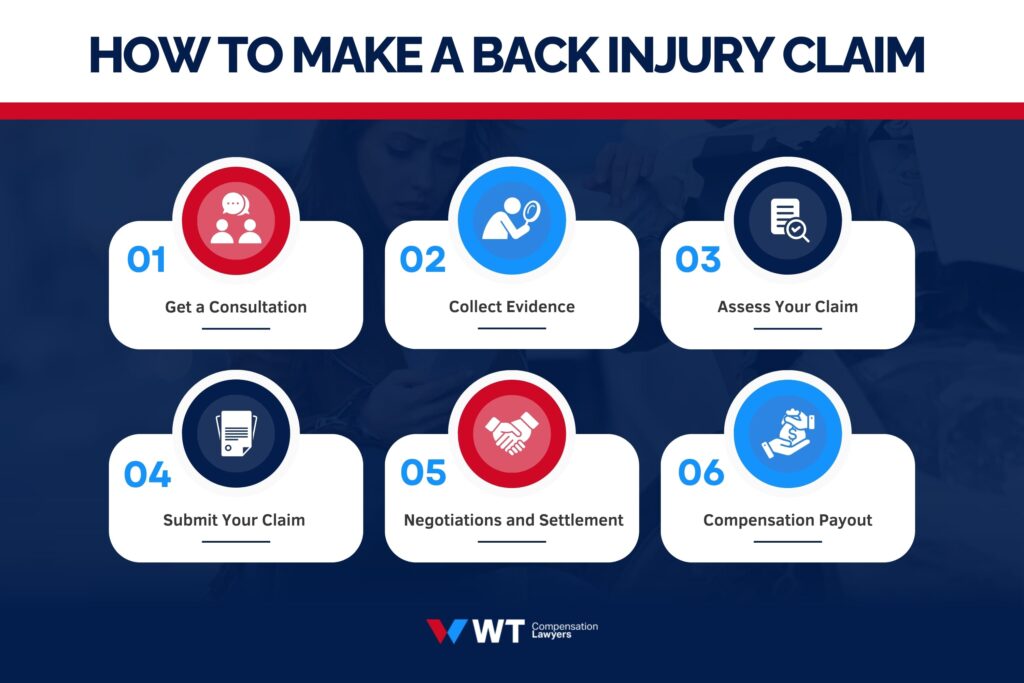
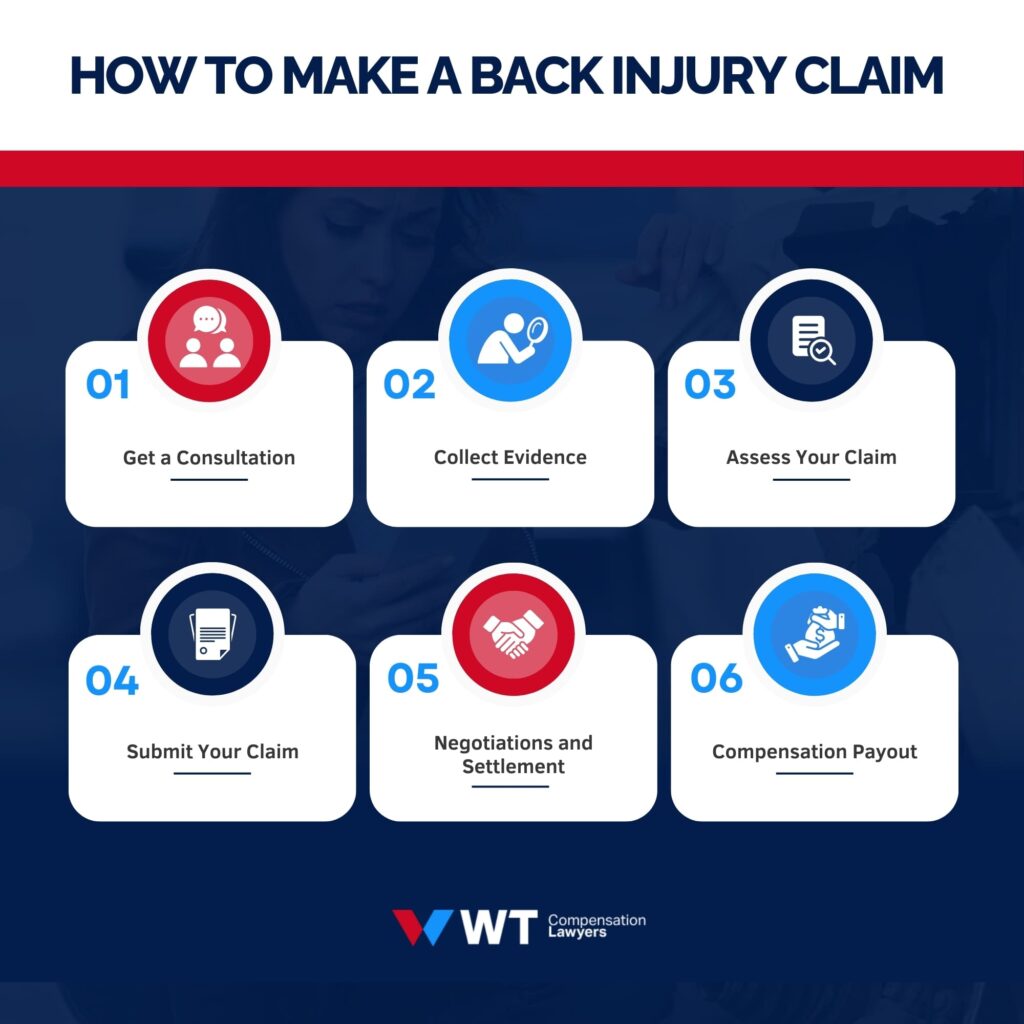
To make a back injury claim, you’ll need to visit a doctor to get medical attention and a medical certificate (work capacity certificate). Then you’ll need to report your injury to your employer. We’d also suggest getting legal advice as soon as possible because workers compensation claims have strict time limits.
Step 1: Get a Consultation
At WT Compensation Lawyers, we recognise that filing a work injury claim can be overwhelming. We also understand the physical and emotional impact that workplace injuries can have. That’s why we offer a free, compassionate consultation to discuss your situation and explore your legal options.
During this consultation, we’ll need to collect important information about your back injury, including when and how the injury happened. WorkCover will need these details when you file your claim, so we’ll help you get all your ducks in a row. Contact us to begin your journey towards fair compensation.
Step 2: Collect Evidence
Our team will help you gather medical reports, witness statements, and other relevant documentation to strengthen your claim. WT Compensation Lawyers will guide you through this process and assess your case based on tangible evidence.
Step 3: Assess Your Claim
You won’t need to do anything at this stage. This is when we’ll assess your case and review the specific details and strengths of your claim. Moreover, we’ll be able to evaluate the potential legal outcome of your case. We’ll also use this assessment to develop a legal strategy and approach for your case.
Step 4: Submit Your Claim
We’ll help you complete the forms and lodge your WorkCover claim online. WorkCover will then investigate and assess your claim and supporting documents. WorkCover will contact you if they need further documents or information related to your case.
Step 5: Negotiations and Settlement
Based on your situation and evaluation of your claim, we will negotiate with the opposing (or at-fault) party or file a lawsuit against them if necessary. Our objective is to reach the best outcome possible, whether through a settlement or a court ruling. Notably, proceeding to court for workers compensation or WorkCover claims is very rare.
Step 6: Compensation Payout
If your claim is successful, you’ll receive compensation for your medical expenses, lost wages, and more. If someone else’s negligence caused your injury, you’ll also be able to pursue a common law claim, which will compensate you for pain and suffering.
Payouts vary depending on how severe an injury is, the impact on your ability to work, and how much medical treatment you need. Your lawyers understand the various compensation avenues, including common law claims, and they will empower you to make informed decisions.
Why Legal Expertise Matters
At WT Compensation Lawyers, we offer invaluable support throughout your claim. Whether you need workplace injury representation or road accident lawyers, we will navigate the legal complexities, negotiate on your behalf, and fight for a fair settlement that reflects your injury’s impact.
Even if at fault, you may have a right to compensation. Start your claims check:
🔒 FREE CLAIMS CHECK TAKES 2 MINUTES
What is WorkCover Back Injury Compensation?
Suffering a back injury at work can be debilitating and financially stressful. Thankfully, Australian workers have WorkCover, a compensation scheme that provides financial support if you’re injured on the job.
What does WorkCover pay for?
WorkCover can cover your medical expenses, lost wages, and permanent impairment benefits if your back injury is related to your work. This includes costs associated with diagnosis, treatment, rehabilitation, and assistive devices.
WorkCover will also compensate your lost wages with payments (weekly compensation), as well as any travel costs related to treatment for your injury. Moreover, WorkCover provides death benefits and covers funeral costs if necessary.
What’s covered under permanent impairment?
If your back injury leaves long-lasting effects, you may be eligible for a lump sum payout based on the severity of your impairment. A medical professional will assess your situation and calculate the injury or any permanent impairment using a specific formula.
How Much Are Back Injury Compensation Payouts in Australia?
Generally, back injury payouts will depend on how severe your injury is. Using data from WorkSafe Queensland on Dominant Injury Items and General Damages, we’ve summarised the amount of compensation you can expect to receive below.
| Item Number | WCR Code | Dominant Injury Description | Range of Injury Scale Value (ISV) | Range of General Damages Awarded in AUD |
|---|---|---|---|---|
| 89 | 08900 | Extreme thoracic or lumbar spine injury | 36 –60 | $98,495 to $204,950 |
| 90 | 09000 | Serious thoracic or lumbar spine injury | 16 – 35 | $32,965 to $94,430 |
| 91 | 09100 | Moderate thoracic or lumbar spine injury – fracture, disc prolapse or nerve root compression or damage | 5 – 15 | $8,350 to $30,270 |
| 92 | 09200 | Moderate thoracic or lumbar spine injury – soft tissue injury | 5 – 10 | $8,350 to $18,470 |
| 93 | 09300 | Minor thoracic or lumbar spine injury | 0 – 4 | $0 to $6,675 |
Disclaimer:These compensation estimates are based on WorkSafe Queensland data and should not be construed as legal advice. Please consult with WT Compensation Lawyers for personalised guidance based on your specific situation. We’re here to take some of the weight off your shoulders by guiding you with expert legal advice and support.
Returning to Work After a Work-Related Back Injury
Returning to work after a back injury will require a gradual and personalised approach. You should work with healthcare professionals and rehabilitation specialists to ensure a safe and successful transition back to your duties.
Back Injury at Work FAQs
After a work-related back injury, you can claim several expenses related to your recovery and well-being such as medical expenses, lost wages, and permanent impairment. Remember that the specific expenses you can claim depend on your individual situation and the laws in your province.
While not mandatory, seeking legal advice for a work-related back injury can be highly beneficial. u003ca href=u0022https://wtlaw.com.au/personal-injuries-qld/lawyers-brisbane/injured-at-work-steps-to-do-after/u0022u003eWork injury claimsu003c/au003e can involve legal procedures and complexities you might not be familiar with. A lawyer can guide you through the process and help you meet all deadlines and requirements. u003cbru003eu003cbru003eMoreover, lawyers understand the factors influencing compensation and can help you gather evidence and build a strong case to maximise your rightful payout. If your claim is initially denied, your u003ca href=u0022https://wtlaw.com.au/personal-injuries-qld/lawyers-brisbane/u0022u003epersonal injury lawyeru003c/au003e can assist you with appeals and ensure your rights are protected throughout the process.
If your work-related back injury claim is initially denied, don’t give up. Each WorkCover authority has a process for reviewing denied claims. This involves providing additional information or clarification to justify your claim. u003cbru003eu003cbru003eA mediator can facilitate a discussion between you and your employer or WorkCover to reach a mutual agreement. If mediation fails, you can appeal the decision with a tribunal, which will make a final judgement based on the evidence presented.
Contact Us
When it’s time to talk, we’re not just lawyers – we’re compassionate listeners. Join us for your free consultation, and let’s take the first step together towards securing the compensation you rightfully deserve.
Even if at fault, you may have a right to compensation. Start your claims check:
🔒 FREE CLAIMS CHECK TAKES 2 MINUTES
Contact us
WT Compensation Lawyers
Address: Level 6, 10 Eagle Street, Brisbane QLD 4000
Phone: (07) 3924 9544
Email: info@wtlaw.com.au
Hours: Monday to Friday, 8:30 a.m. to 5:00 p.m.
Back to Top: Back Injury at Work – Compensation Guide